

Illuminating the Inner Life: An Elul Practice in Color
This spring, I got a piece of bad news in the midst of what was meant to be a happy time: my twins would be graduating from college… on the same day. One in San Francisco. The other in Southern California. As their mother, it felt like an impossible situation. How could I watch only one of my kids cross the stage?
I turned to a piece of wisdom I had been carrying with me since the prior fall. Every year before Rosh Hashanah, I pull a card from a deck I created: Illuminated Paths. Its colorful cards make Jewish wisdom accessible and intuitive when we need clarity or are making a choice.
Last year, I turned over Flow, and that word became my anchor for the year.
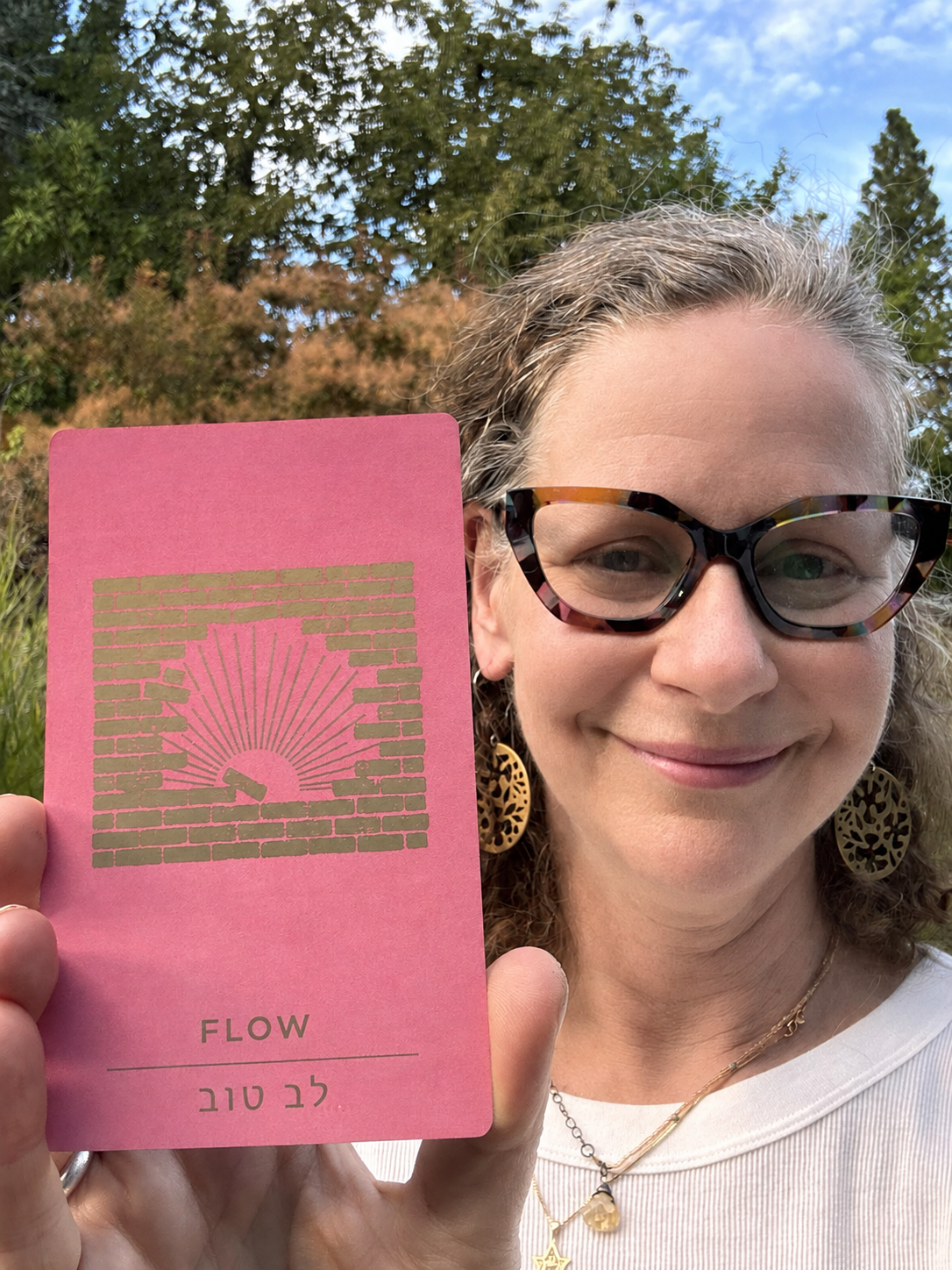
Flow is the practice of letting go of expectations and the need to force an outcome. It frees us to respond authentically, with an open heart.
After years of asking what everyone else needed, Flow kept bringing me back to a question I rarely asked myself: What would be good for my heart?
When I reflected on my conundrum, I knew the answer: I needed to see both my kids graduate.
We toasted our daughter in San Francisco the night before and watched her graduate at noon. Then we made a mad dash to the airport — with her! — flew to Southern California, took an Uber, and watched her brother cross the stage six hours later.
Going with the flow did not mean that we stopped planning. We planned like crazy. I simply let go of the idea that there was one right way to celebrate them.
Illuminated Paths has been there for me through many momentous decisions in the past few years: a gift from myself to myself, and the world.
It all began when my kids were preparing to head off to college. It was Elul, I had just turned 50, and my children were about to leave home and begin lives of their own. All at once, I was faced with the realization that I had no vision for my life without them.
I decided I needed to find a way to listen inward, so that afternoon I set out for a walk in Forest Park. But as I walked the trails, instead of taking in the beauty of the trees or listening to my heart, all I could think about were my doubts. When I reached an intersection of several trails, I had no idea which one would lead me back to my car.
It was 4:30 p.m. The light was fading.
Standing alone in the forest, I cried out as if in prayer: “Why is it that all the wisdom I have collected over my lifetime is never accessible when I actually need it?”
I paused and looked around. One particular trail sign caught the remaining light and seemed to sparkle. Somehow, I knew it was the way back.
Suddenly, I envisioned a map that would use color to bring sacred wisdom back into view in times of need.
We tend to think about color as decoration or preference. We ask one another: What is your favorite color? We ask ourselves: What color looks good on me?
But color is how we see light. It is what reveals the world to us. What if color could also help us see our inner light: the qualities, struggles, and strengths moving within us?
I have been fascinated by color since studying art in college. Later, as a market researcher, I used color-coded charts to help people express experiences they could not easily put into words. Once their thoughts were spread across a wall, people could recognize patterns they had felt but had not yet been able to name.
Now, I realized I could use these same principles to help people find their way home.
I began creating my map, labeling colors with qualities in English and with Hebrew words that spoke to me. There were 48 in all. Then I discovered that Pirkei Avot, a collection of Jewish ethical teachings, describes 48 ways of acquiring Torah.
This discovery led to years of exploring how each of those colors related to Torah and to Jewish teachings about cultivating character. The result was the Illuminated Paths deck and its accompanying Oracolor Wheel — a map of sacred wisdom in vibrant, rainbow colors. This visual framework can help us face challenges, recognize opportunities, draw on strengths, and live in alignment.
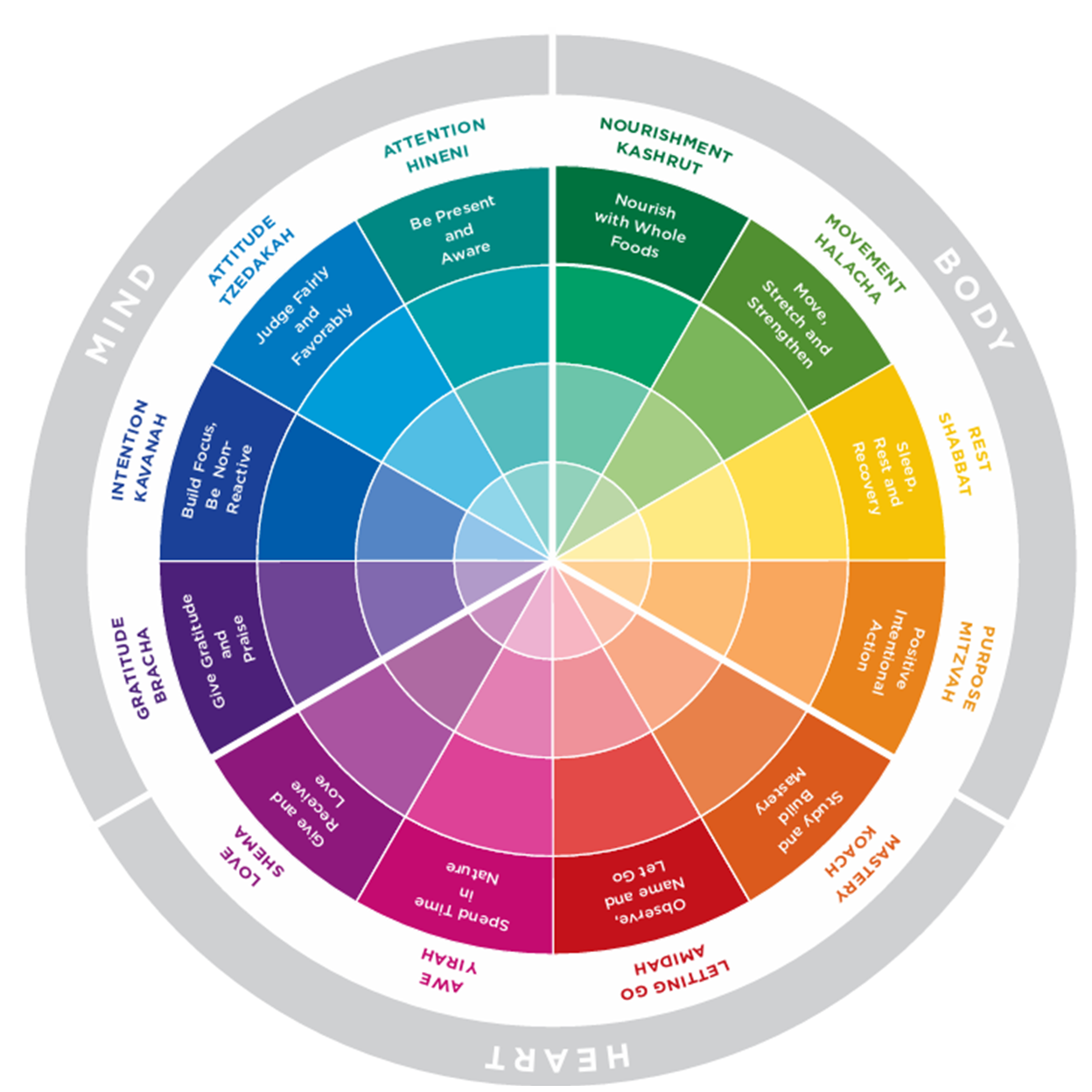
The Oracolor Wheel centers our core values, the qualities we most want to live. We experiment with ways of embodying them. When something helps, we make it a practice. The more we live and celebrate our deepest values, the easier they are to return to when life gets hard.
The month of Elul is one such time. Each year before Rosh Hashanah, throughout the Hebrew month of Elul, tradition teaches us to conduct an “accounting of the soul,” or Cheshbon Ha-Nefesh. We look honestly at the year we have lived and consider what we want to carry into the year ahead.
Oracolor makes these reflections visible.
How to use the Oracolor Wheel at the new year
Find a quiet space to reflect on the past year. In a journal, consider:
What did this year reveal about you?
What quality do you want to bring more fully into the year ahead?
Find that quality on the Wheel and note its associated color. In your journal, come up with one small way to practice it. Then, as you move forward, keep its color somewhere visible. Draw a line of it in your journal, wear it, or make it the background on your phone.
Whenever the color catches your eye, reflected by the world around you, pause.
A truth about ourselves can be real and still be easy to forget.
Elul gives us time to bring it back into view, to see more of who we have been, and to listen for what wants to come forward.
What color will help you remember?
At The Well uplifts many approaches to Jewish practice. Our community draws on ancient Jewish wisdom, sometimes adapting longstanding practices to more deeply support the well-being of women and nonbinary people. See this article’s sources below. We believe Torah (sacred teachings) are always unfolding to help answer the needs of the present moment.
Sources
- Pirkei Avot 6:6, Sefaria.org
- Kitzur Shulchan Arukh 128:1 (Elul acronym)
- Moses Cordovero, Or Ne’erav, Part VI — explains that colors are assigned to the sefirot according to the qualities or actions they express.
- Menachot 43b — The blue pathways of Attitude and Attention draw on the rabbinic teaching about tekhelet, the blue thread worn among the fringes of a four-cornered garment: “Tekhelet resembles the sea, the sea resembles the sky, and the sky resembles the Throne of Glory.”

Debbie Plawner is the creator of Oracolor and the author of Illuminated Paths: 52 Ways to Access Your Inner Wisdom Through the Colors of Torah. Building on 25 years as a market researcher and strategist, she’s developed Oracolor as a visual framework bringing Jewish wisdom to life through the language of color. Learn more at oracolor.com.